
Last updated October 31, 2026
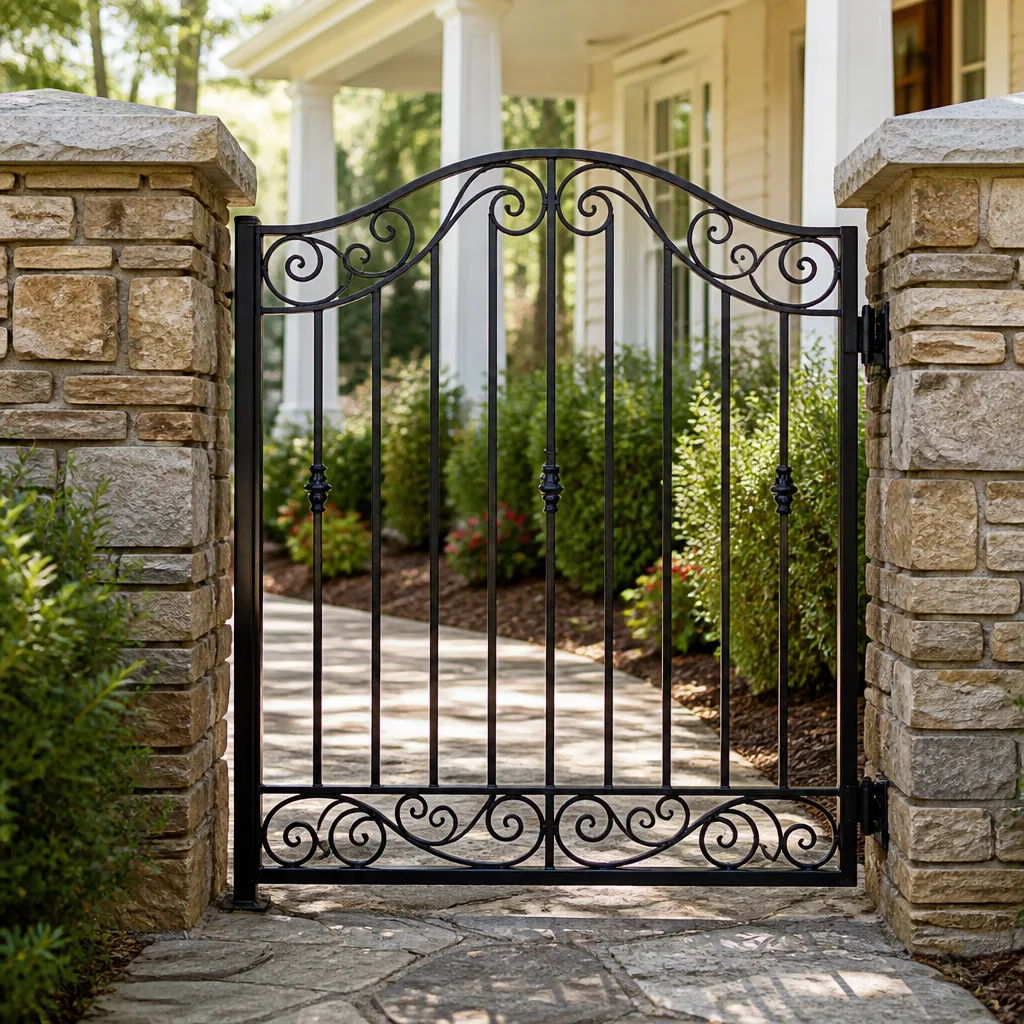 Wrought iron
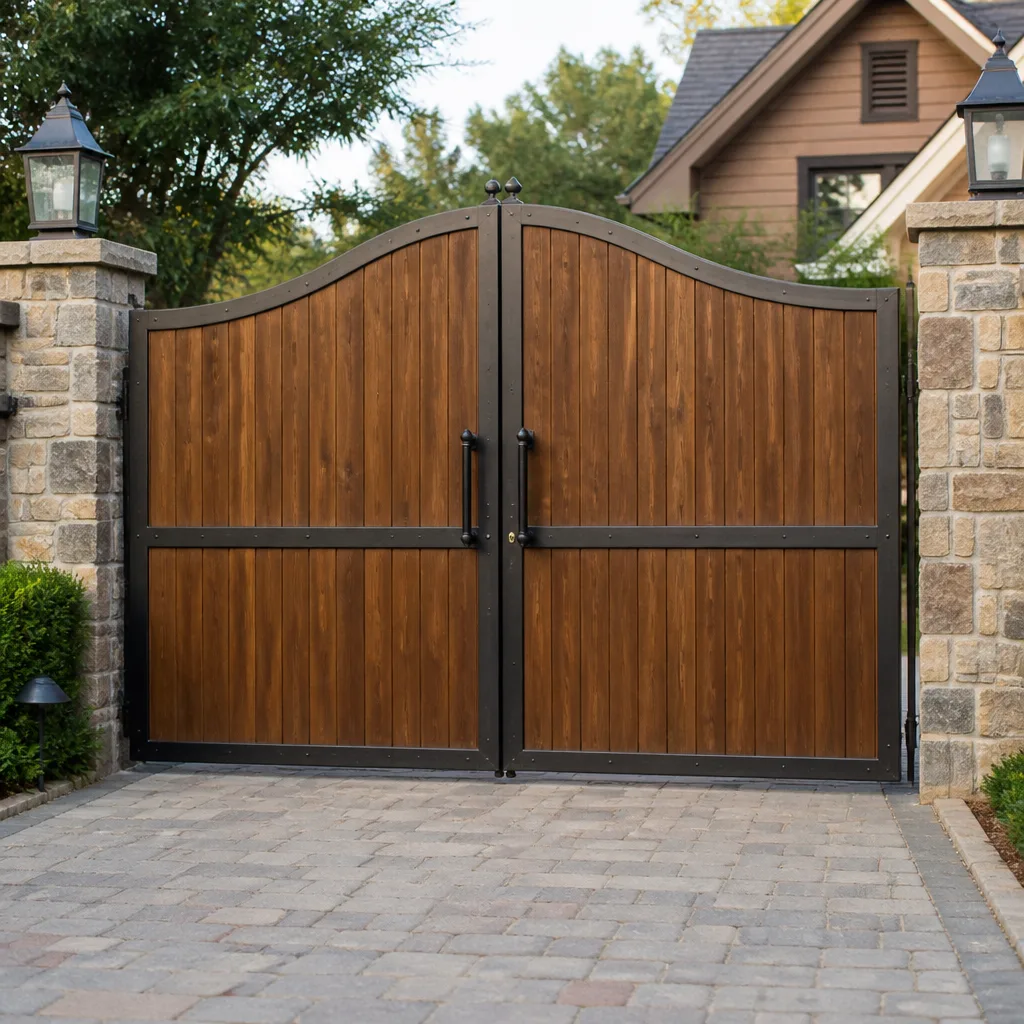 Wood & steel frame
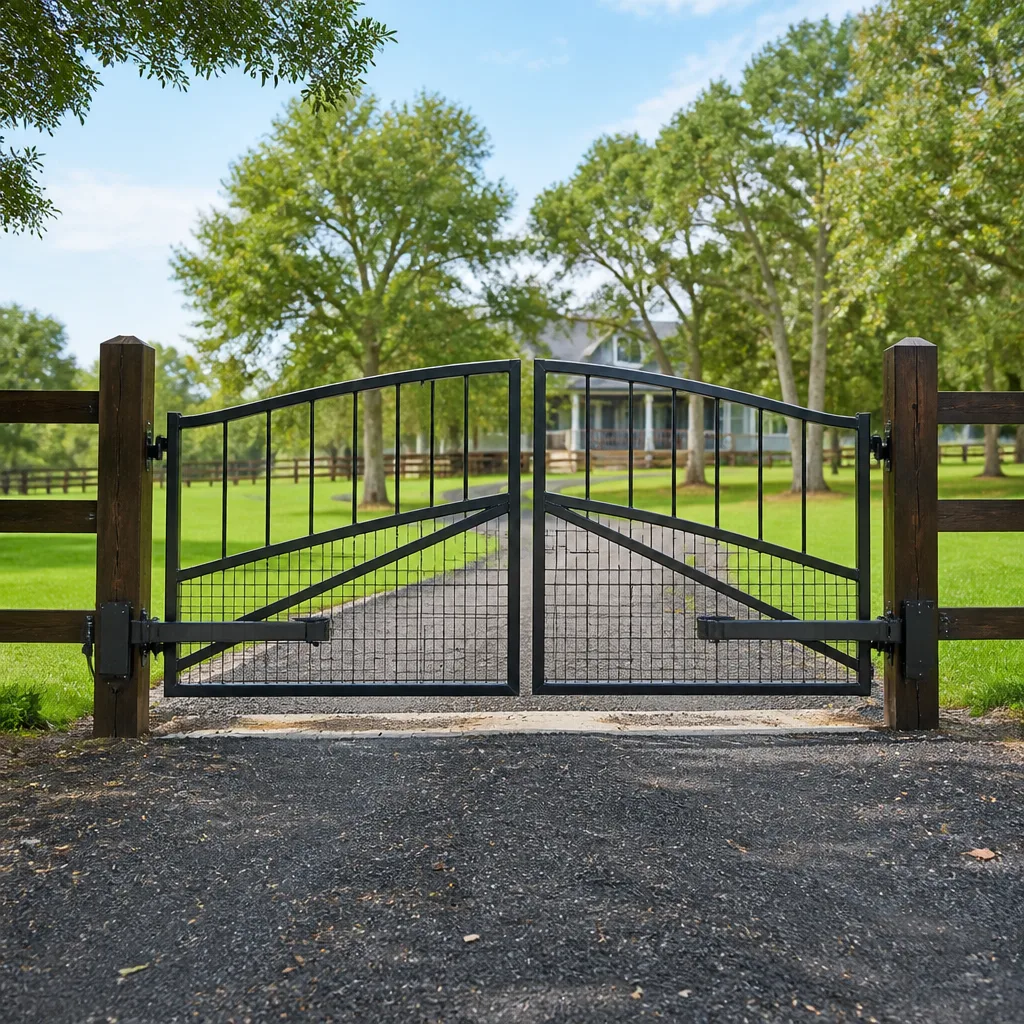 Farm & ranch
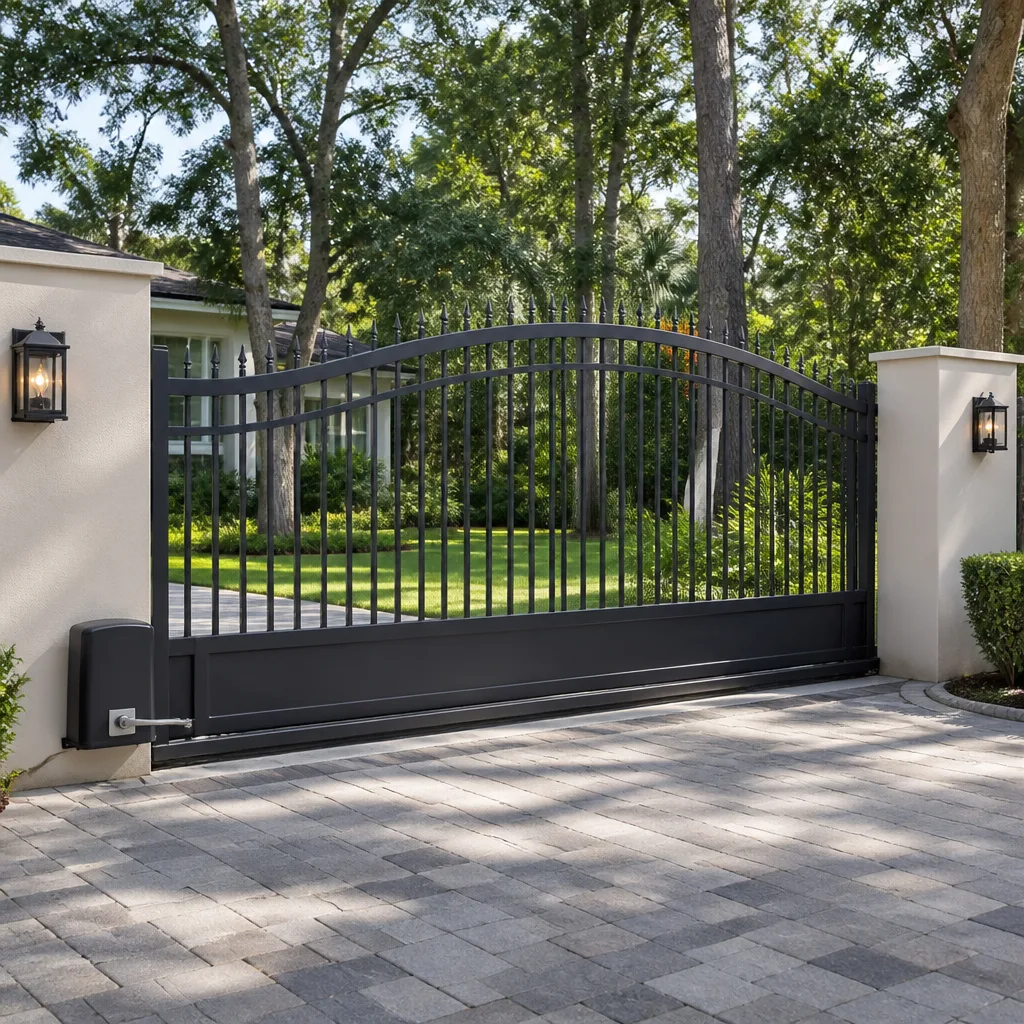 Sliding driveway gates
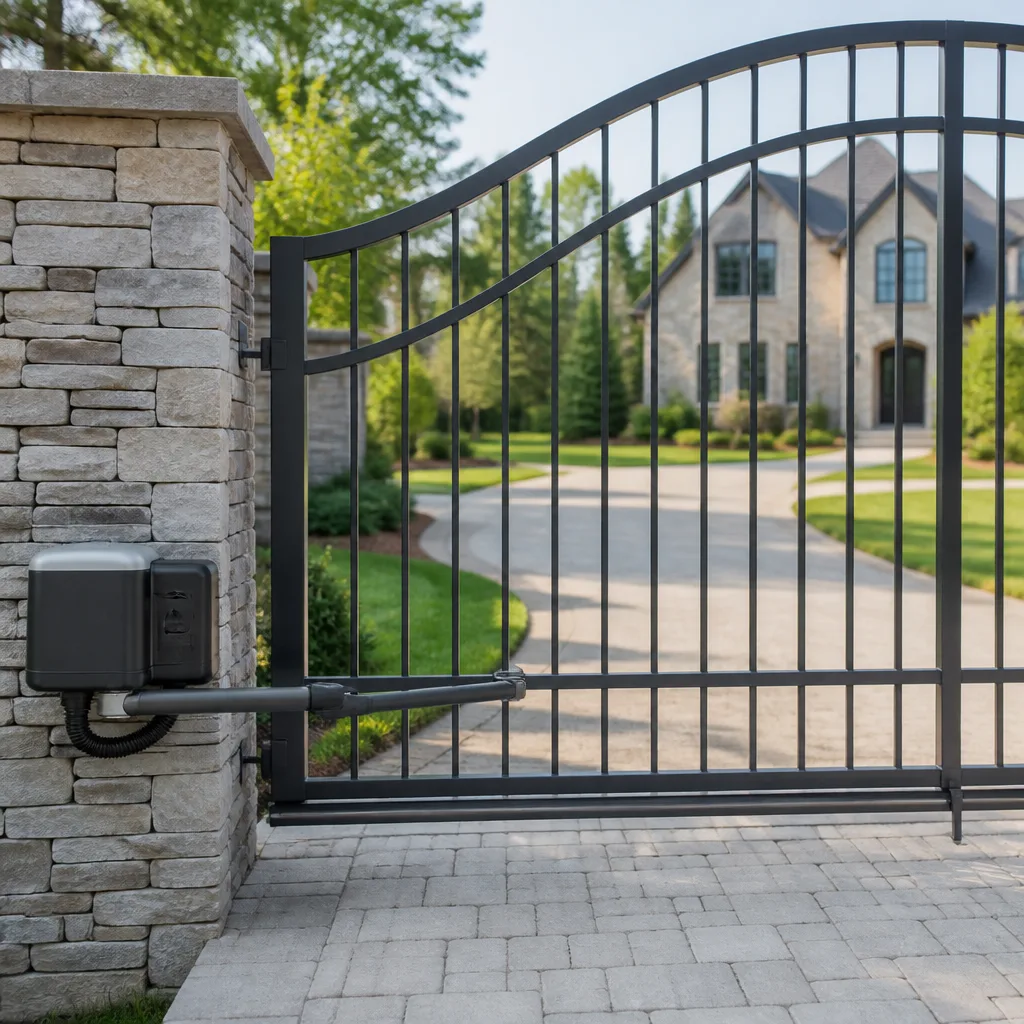 LiftMaster operators
Free on-site gate assessment - hinges, posts, and your LiftMaster or Nice gate operator checked before anything is quoted
The assessment is free and the quote is the invoice.
Get your free estimateDIY vs Professional Gate Repair: The Tampa Homeowner’s Decision Guide
The most dangerous gate repair a homeowner can attempt isn’t the electrical work. It’s adjusting a torsion spring on a slide gate, which stores enough mechanical energy to snap bone if it releases wrong. The spring looks passive, like a coiled piece of steel waiting to be nudged. It isn’t. Tampa emergency rooms see gate-related injuries every year that trace back to exactly that assumption. This guide will walk you through which gate repairs you can safely handle yourself, which ones will cost you more in the long run, and which ones should never touch your weekend to-do list. For professional help, see our Gate Repair services.
Quick Answer
Basic gate maintenance like cleaning tracks, tightening bolts, and lubricating hinges is DIY-safe for most Tampa homeowners. Anything involving torsion springs, electrical control boards, or automated operator internals should go to a licensed professional. The dividing line is whether the component stores mechanical or electrical energy, and whether Florida code requires a licensed contractor for the work. For Gate Repair Cost Breakdown: The Tampa Homeowner’s Reference for 2026, see our detailed pricing analysis.
Styles & brands we work with
Table of Contents
- What’s Actually DIY-Safe on a Gate
- The Torsion Spring Problem No One Talks About
- Florida Code and the Electrical Work Question
- Warranty Implications Most Homeowners Never Read
- The Tool Reality Check: Why ‘Simple’ Repairs Aren’t
- Tampa’s Climate and the Hidden Cost of a Botched Fix
- Task-by-Task Breakdown: DIY, Risk, or Pro
- Common Mistakes to Avoid
What’s Actually DIY-Safe on a Gate
Let’s start with what you can genuinely do yourself without risking injury, code violations, or a voided warranty. These are the maintenance tasks that keep a gate running smoothly between professional service visits, and they’re the same ones we recommend to every Tampa homeowner we serve.
Lubrication tops the list. Gate hinges, rollers, and chains need regular lubrication in Florida’s humidity. The salt air near Tampa’s bayfront neighborhoods accelerates corrosion on metal components that go dry. A silicone-based lubricant applied every three to four months to hinge pins and roller bearings extends the life of those parts measurably. This is a 15-minute job that requires no special tools.
Cleaning the track on a slide gate is another safe task. Tampa’s rainy season drops leaves, pine needles, and debris into gate tracks constantly. When a slide gate starts jerking or grinding, the track is usually clogged. Clearing it with a stiff brush or compressed air is straightforward. So is clearing the photo-eye sensors on an automatic gate; dust and spider webs trigger false obstructions that make the gate reverse for no reason.
Visual inspection is the most underrated DIY task. You know your gate better than anyone. Noticing that a hinge is sagging, a weld is cracking, or a wheel is wearing unevenly before the failure becomes catastrophic is something only you can do. Document what you see and call a gate specialist with specifics.
Here’s a quick reference list of genuinely safe DIY tasks:
- Lubricate hinges, rollers, and chains with silicone spray every 3-4 months
- Clean slide-gate tracks of leaves and debris, especially during Tampa’s wet season
- Wipe down photo-eye sensors and verify they’re aligned
- Tighten visible bolts and fasteners on the gate frame and hinges
- Trim vegetation that interferes with gate swing or slide travel
- Repaint or seal a metal or wood gate to prevent rust and rot
- Test the auto-reverse function and note any inconsistency for the next service call
That’s it. These seven tasks cover about 80% of what a homeowner should reasonably attempt. The other 20% of common gate maintenance, like chain tensioning and hinge replacement, sits in a gray zone we’ll cover below.
The Torsion Spring Problem No One Talks About
When you search “gate repair DIY” online, most advice skips over springs entirely. That’s a problem, because torsion springs on slide gates fail more often in Tampa than almost anywhere else in the country. The humidity, the salt air, and the constant temperature swings between air-conditioned garages and 95-degree driveways all stress spring steel. When a torsion spring breaks or comes off its mount, it doesn’t fail gently.
Here’s the physics most people miss. A gate torsion spring stores energy proportional to the gate’s weight and travel distance. A 300-pound driveway slide gate produces significant stored-torque load. When that energy releases incorrectly, the spring becomes a projectile. The hardware and mounting brackets become shrapnel. This isn’t a scraped knuckle situation; it’s a broken bone or worse.
We’ve seen the aftermath of DIY spring adjustments. Crushed fingers. Lacerated forearms. One homeowner in North Tampa attempted to re-attach a spring with a pry bar and ended up with a fractured wrist when the tool slipped. The emergency room visit cost more than the professional repair would have.
What makes it more deceptive is that the spring looks approachable. It’s just a coiled piece of steel with some bolts. But the manipulation requires tensioning bars, correct torque specifications, and an understanding of how the gate’s weight interacts with spring rate. One wrong move and the spring unwinds violently.
If your gate has a torsion spring that’s broken, sagging, or making a creaking noise that gets worse each week, call a professional. This is not a judgment on your handiness. It’s a recognition that some tools require training, and some energy sources don’t forgive mistakes.
Florida Code and the Electrical Work Question
Some gate electrical work isn’t just risky. It’s technically illegal for an unlicensed person to perform in Florida. That’s a distinction most DIY guides never mention, and it’s the part of this decision Tampa homeowners most frequently overlook.
Florida’s building code and electrical code treat gate operators differently from, say, a ceiling fan. An automated gate system that runs on 120V or 240V line voltage is an electrical installation. Wiring a new operator, running conduit for a power supply, installing safety loops in the driveway, or connecting an intercom system to line voltage all require a licensed electrical contractor under Florida law. The law exists because a wiring error on a gate can energize the gate frame itself, creating a shock hazard that affects every person who touches it.
Low-voltage work on the control board side, like replacing a photo-eye sensor wire or a keypad, sits in a gray area that varies by municipality. Tampa’s code enforcement has grown stricter in recent years about unpermitted electrical work on automatic gates, especially on properties that front public right-of-ways. The risk isn’t just a fine. If an unpermitted electrical modification fails and damages property or injures someone, the homeowner’s insurance may decline the claim.
This is why electric gate repair in Tampa should involve a professional who understands both the mechanical gate system and the electrical code surrounding it. The two disciplines intersect on every automatic gate, and troubleshooting one without understanding the other creates new problems.
What about swapping a control board? That’s where most homeowners get into trouble. The board itself may be low-voltage, but the inputs to it aren’t. And board replacement requires matching firmware versions, re-adding all remote controls, and recalibrating the gate’s travel limits and force settings. It’s closer to programming than it is to mechanical assembly.
Warranty Implications Most Homeowners Never Read
Before you open a single panel on your gate operator, check your warranty. The fine print on most major gate operator brands matters more than homeowners realize. This is the hidden cost you can’t see until the manufacturer denies your claim.
Here’s what the warranty language typically says on brands like Ghost Controls, DoorKing, Elite, and Mighty Mule: internal component work performed by anyone other than an authorized technician voids coverage. That’s not a suggestion. It’s a contractual term. The manufacturer has no way to verify that a homeowner’s control board replacement was done correctly, so they reserve the right to wash their hands of all future claims on that unit.
The practical impact is significant. If you DIY a control board replacement on a DoorKing operator and the new board fails three months later, you’re buying another board. If a certified technician does the same replacement and the board fails, it’s covered. The part cost might be identical, but the downside risk is entirely different.
We’ve also seen warranty claims denied because a homeowner’s partial repair created the conditions for a later failure. A misaligned actuator on a Mighty Mule system puts stress on the gear train. Six months later, the gear strips. The manufacturer inspects the unit, sees the actuator misalignment, and denies the claim. The homeowner is now paying for a full gear assembly replacement that would have been free.
The same warranty logic applies to gate repair in Tampa more broadly. When you hire a certified technician, the labor and parts carry their own warranty separate from the manufacturer’s coverage. That’s a second layer of protection a DIY fix never provides.
The Tool Reality Check: Why ‘Simple’ Repairs Aren’t
The phrase “simple repair” on a YouTube thumbnail usually means the video’s author owns specialized tools they don’t mention. Gate repair is full of these hidden requirements. The tools that make a “simple” job simple are often the ones no homeowner owns.
Operator calibration is the clearest example. A Ghost Controls or Mighty Mule operator has acceleration, deceleration, and force parameters that must be set precisely. Too much force and the gate becomes a liability in a crushing incident. Too little force and the gate stalls on windy days. Setting these parameters requires either proprietary diagnostic software or a handheld programmer that costs hundreds of dollars. There is no workaround using the little adjustment screws visible on the control board.
Torque specifications are another hidden requirement. Gate hinges, operator mounts, and wheel assemblies all have specific torque values. Overtighten a hinge bolt and you distort the hinge plate against the post. Undertighten it and the bolt works loose within a month. Professional gate work uses torque wrenches and manufacturer torque charts. Guessing at bolt tightness is how gates end up sagging.
Solder and crimping skills matter on electrical repairs. A gate that moves dozens of times daily vibrates every wire, connector, and splice. A poorly crimped wire connection on a sensor loop will work fine on day one and fail intermittently two weeks later. Intermittent electrical faults are the hardest problems for any technician to diagnose, and they’re the most common legacy of DIY electrical work.
Then there’s the diagnostic equipment. When a gate system acts erratically, a professional doesn’t start replacing parts. They check voltages at the board, test the loop detector frequency, verify the actuator draw under load, and inspect the ground continuity. These tests require multimeters, loop detectors, and amp probes. Without them, diagnosis becomes guesswork. Guesswork becomes parts-swapping. Parts-swapping becomes expensive.
Tampa’s Climate and the Hidden Cost of a Botched Fix
Tampa has a specific problem that DIY gate fixes make worse: the wet season runs from June through September, and it’s ferocious. A gate that sits even slightly misaligned through those months develops problems that compound silently.
Here’s the scenario we see repeatedly. A homeowner adjusts gate hinges to fix a sag, gets the alignment close but not perfect, and the gate now sits a quarter-inch off at the latch. During dry season, that quarter-inch means nothing. When the daily thunderstorms arrive, rainwater runs down that misaligned seam. The gate frame soaks. If it’s wood, rot sets in. If it’s hollow steel, rust forms from the inside where you can’t see it.
By the time the homeowner notices the damage, the fix has expanded from a hinge adjustment to a frame repair, new hinges, and often a new gate panel. A $300 professional hinge repair became a $1,800 gate replacement because the adjustment wasn’t precise enough. The humidity in Tampa doesn’t give second chances on metal and wood that stay wet.
The salt air near the coast adds another layer. Homeowners in South Tampa, Davis Islands, and along Bayshore Boulevard deal with corrosion rates that inland neighborhoods like New Tampa and Carrollwood don’t experience. A galvanized hinge that lasts 15 years in Carrollwood might last 7 in South Tampa. A DIY repair that uses the wrong fastener material, like a plain steel bolt instead of stainless, begins corroding within weeks near the bay. Professional gate work in coastal Tampa neighborhoods specifies stainless fasteners and marine-grade coatings by default.
This climate context changes the DIY calculus. A repair that’s perfectly reasonable for a homeowner in Arizona or Colorado may be a bad idea in Tampa simply because the local environment punishes imprecision more harshly.
Task-by-Task Breakdown: DIY, Risk, or Pro
This is the table we wish every Tampa homeowner had before starting a gate repair. It separates gate tasks into three categories based on energy, code, and warranty risk.
| Task | Category | Why |
|---|---|---|
| Lubricating hinges and rollers | DIY-safe | No stored energy. No code issue. No warranty concern. |
| Cleaning slide-gate track | DIY-safe | Purely mechanical debris removal. No disassembly. |
| Cleaning photo-eye sensors | DIY-safe | Surface cleaning only. Alignment check is visual. |
| Tightening visible bolts | DIY-safe | No specs required for basic snugging on non-structural fasteners. |
| Repainting or sealing gate | DIY-safe | Surface treatment only. No mechanical or electrical involvement. |
| Replacing gate wheels or rollers | DIY-possible with risk | Weight-bearing. Requires supporting the gate. Wrong torque on axles causes premature wear. |
| Adjusting chain tension | DIY-possible with risk | Too tight stresses operator. Too loose causes chain jump. Spec matters. |
| Replacing a keypad | DIY-possible with risk | Low-voltage but requires reprogramming. Incorrect wiring damages the board. |
| Replacing a hinge | DIY-possible with risk | Gate must be supported and realigned. Sagging if done imperfectly. |
| Adjusting torsion spring | Professional only | High stored energy. Severe injury risk. Specialized tensioning tools required. |
| Control board replacement | Professional only | Warranty void if non-certified. Requires calibration tools and firmware matching. |
| Running new line-voltage wiring | Professional only | Requires licensed electrical contractor under Florida code. Insurance implications. |
| Installing safety loops in driveway | Professional only | Requires concrete cutting. Loop frequency must be tuned to the specific operator. |
| Actuator or operator replacement | Professional only | Load calculation required. Incorrect sizing burns out new units prematurely. |
This table isn’t about protecting trade secrets. It’s a realistic assessment of what the work involves. If you’re comfortable with the “DIY-possible with risk” category, that’s your call to make as a homeowner. But go into it knowing the specific failure modes, not just the broad strokes.
Common Mistakes to Avoid
If you do attempt a DIY gate repair, avoid these specific mistakes. Each one comes from real service calls in the Tampa area where a well-intentioned repair created a bigger bill.
- Using WD-40 instead of proper lubricant. WD-40 is a water displacement formula, not a lubricant. It dries out and leaves a residue that attracts dust. Use silicone spray or white lithium grease on gate components.
- Overtightening everything. Hinge bolts, operator mount bolts, wheel axles, all have torque specs for a reason. A wrench cranked as hard as possible warps metal, distorts plastic bushings, and strips threads. Snug is not the same as correct.
- Ignoring the gate’s auto-reverse sensitivity. After any repair that touches the gate’s movement, the force settings must be reverified. A gate that closes too hard is a crushing hazard. Test it and adjust or call a professional who can.
- Replacing a control board without noting the original wire positions. Control board terminals are labeled, but a single misconnected wire can fry the new board on power-up. Take photos before removing anything.
- Buying the cheapest replacement part online and expecting it to last. In Tampa’s climate, a powder-coated hinge from a no-name supplier rusts within a season. The part that failed was likely installed because it was cheap. Match or exceed the original spec.
- Leaving the gate half-disassembled overnight. Tampa’s afternoon thunderstorms arrive with no warning. A gate with an exposed control board or disconnected actuator gets damaged in minutes. Finish the job or close everything up before you walk away.
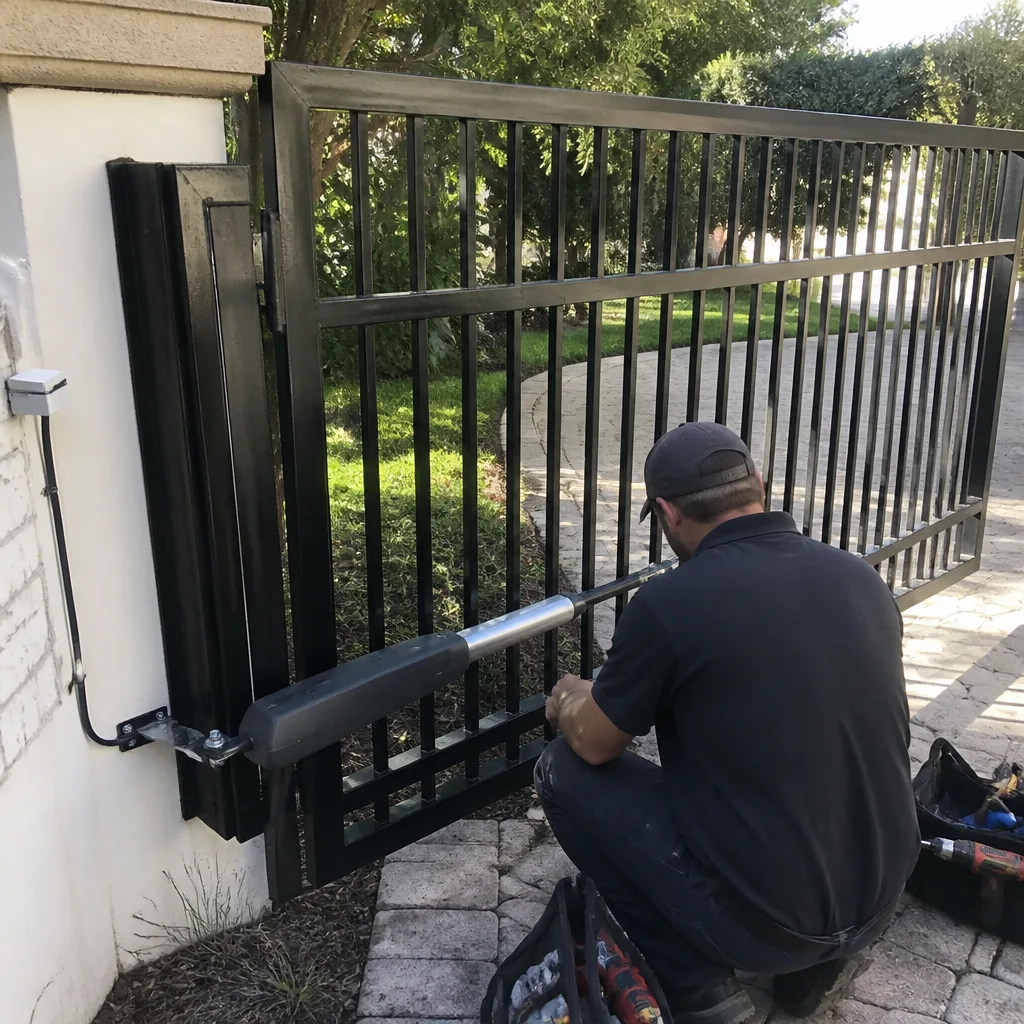
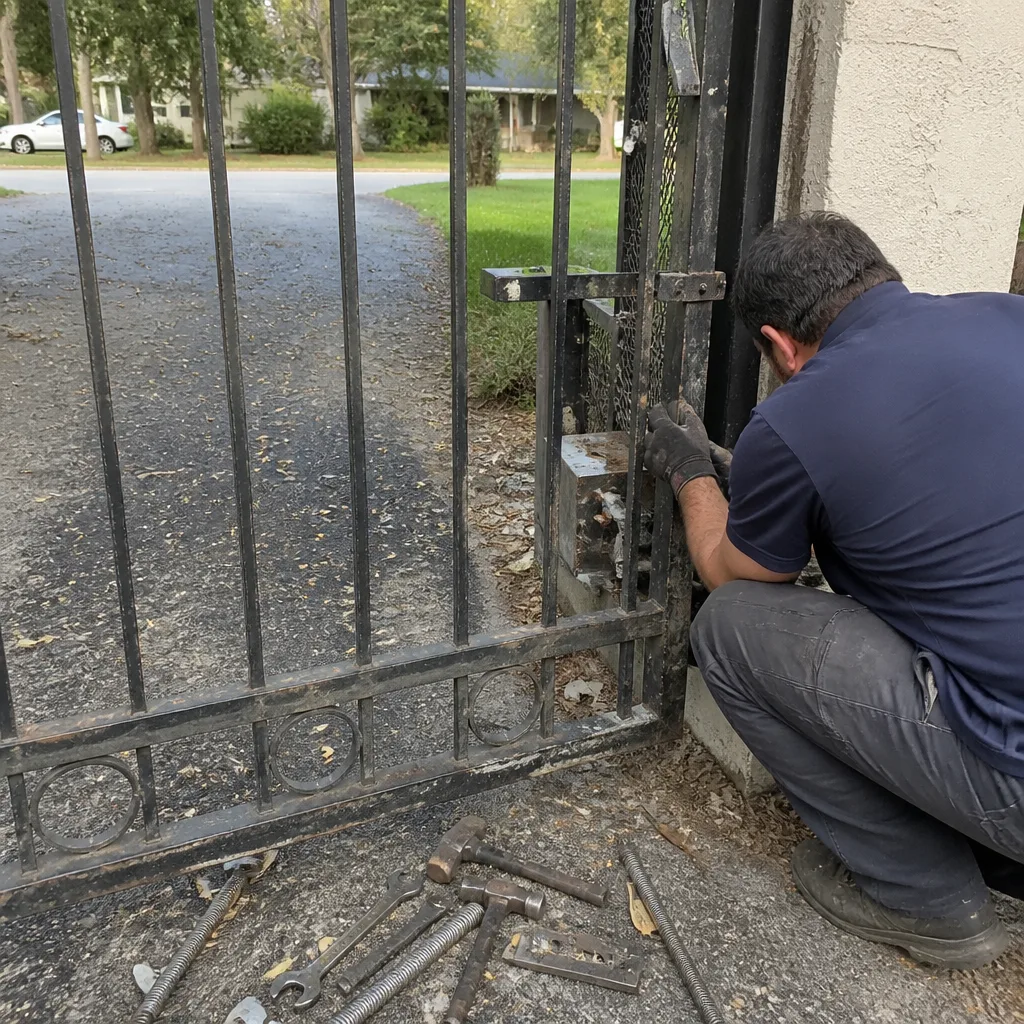
See the difference
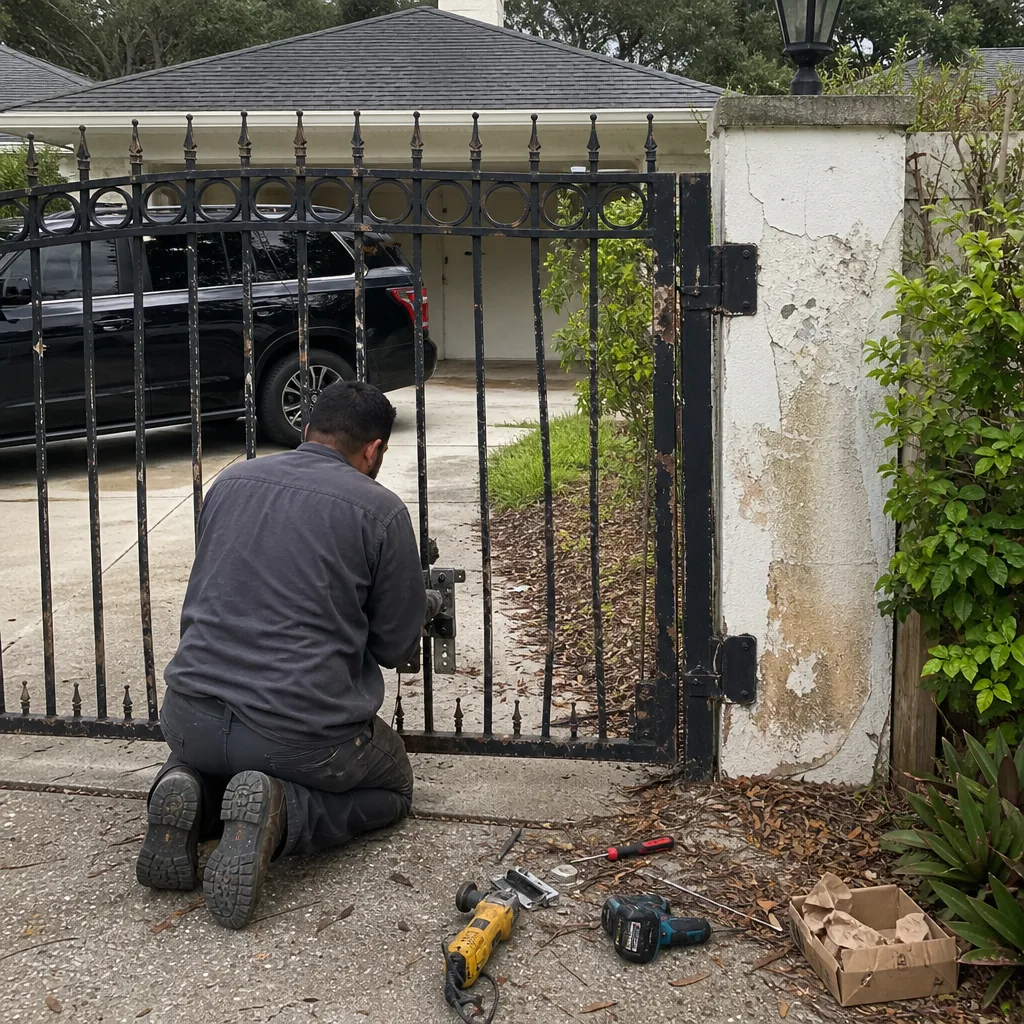 Before
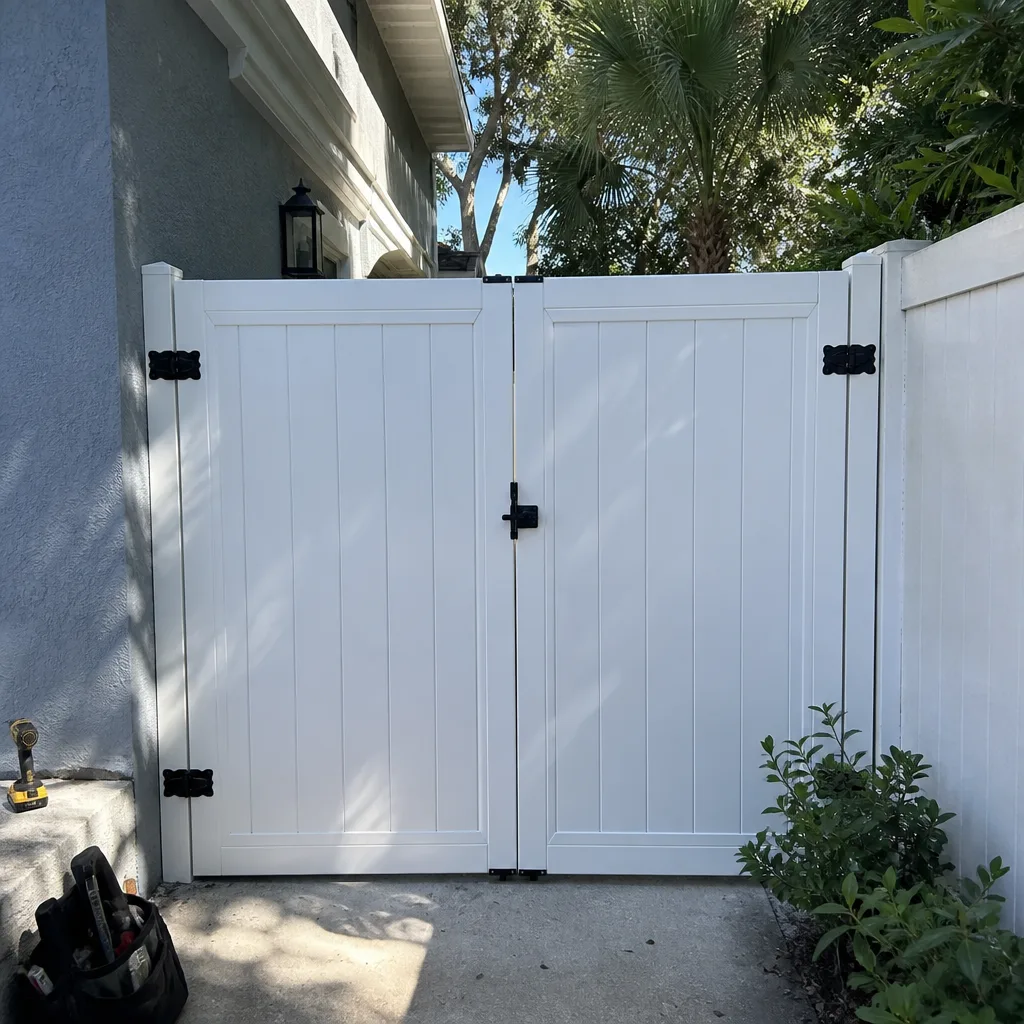 After
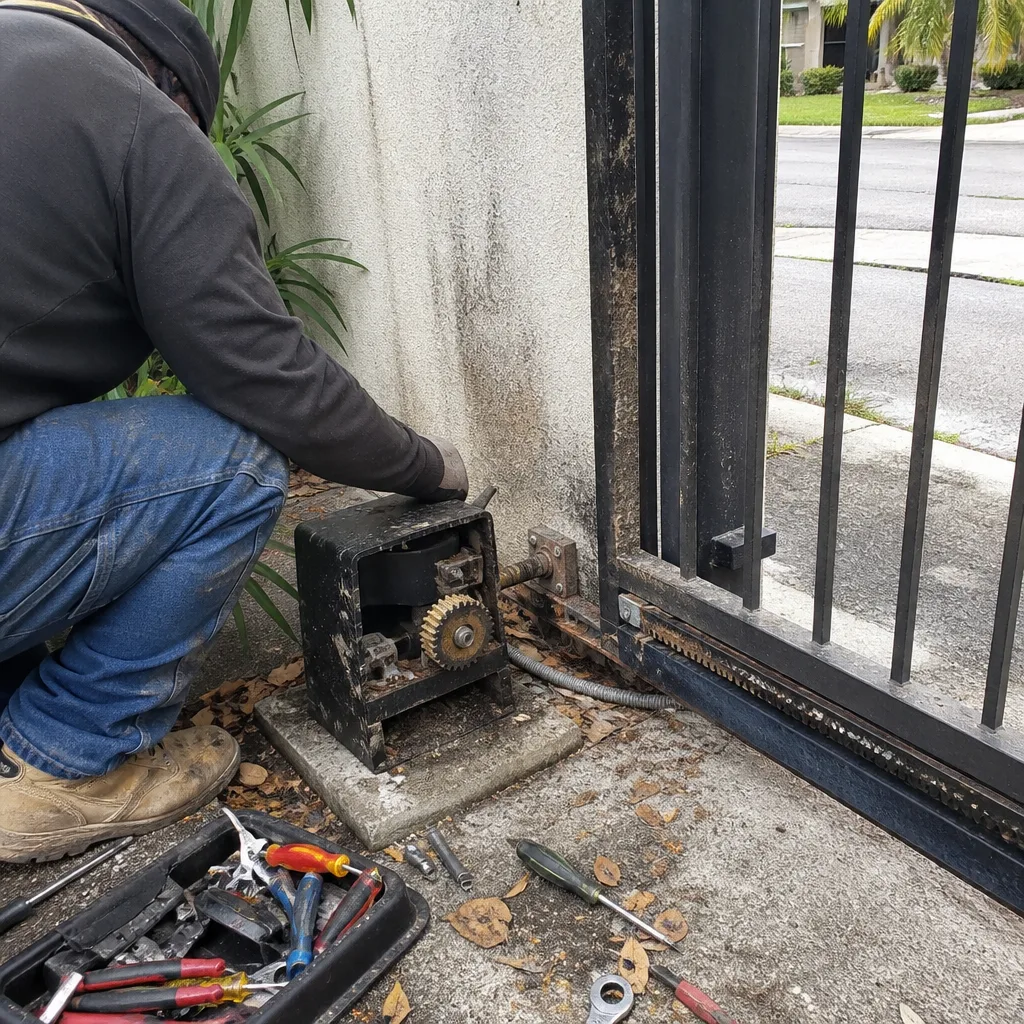 Before
 After
 Before
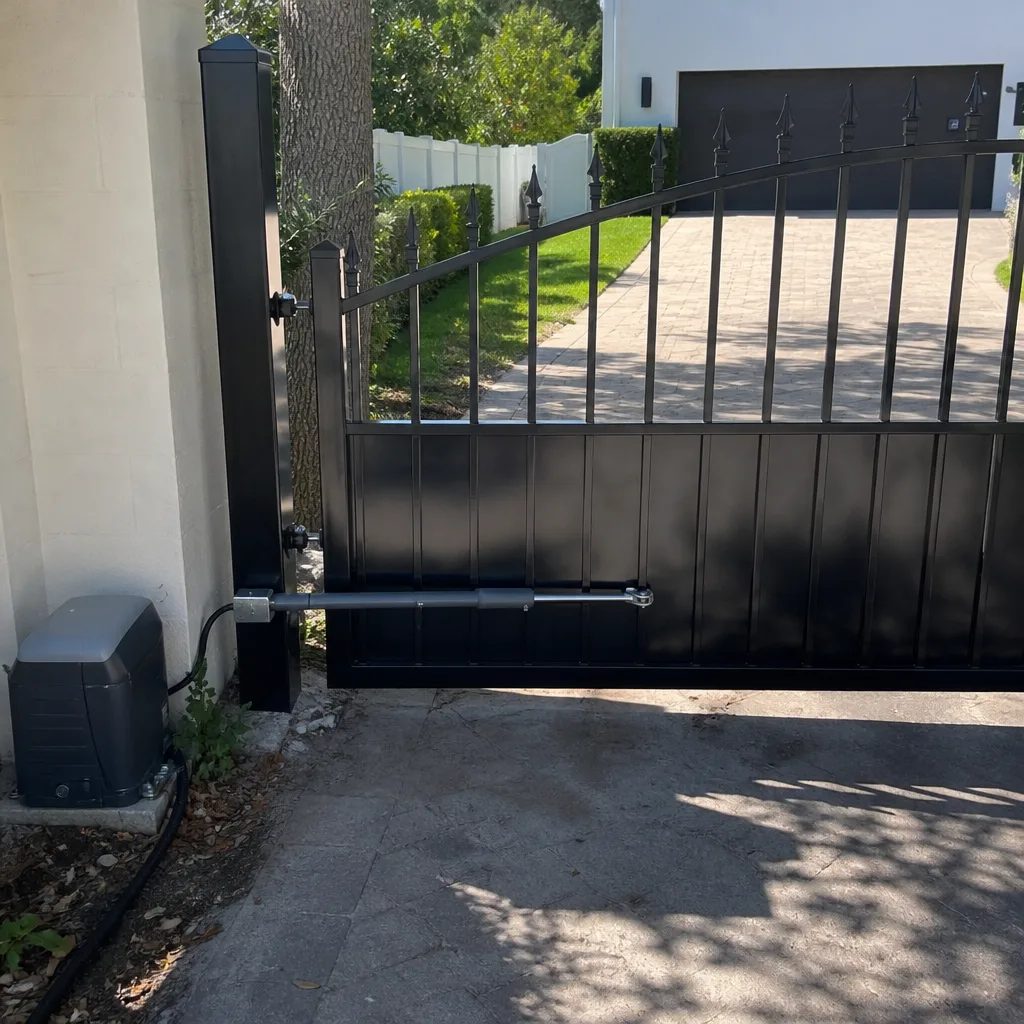 After
When to Call a Professional
Here’s the short list. Call a professional if your gate has a torsion spring issue, any electrical symptom that isn’t a dirty photo-eye, a control board that shows signs of burning or corrosion, an operator that’s been in service more than 10 years and is failing for the second time, or any repair you’ve already attempted once without lasting success. The second-attempt repair is almost always more expensive than the first-attempt professional repair would have been.
Kingston Gate Repair offers free estimates in Tampa. We work on Ghost Controls, DoorKing, Elite, and Mighty Mule systems among others, with certified technicians who diagnose and repair in one visit using brand-specific calibration tools and stocked parts for gate installation in Tampa as well. Call (877) 752-3303 for an honest assessment of whether your repair is DIY-safe or needs a specialist.
Frequently Asked Questions
You can handle basic maintenance like lubrication and track cleaning yourself. Electrical repairs involving control boards, line-voltage wiring, or operator calibration should go to a licensed professional, both for safety and because Florida code restricts unlicensed electrical work on automated gate systems attached to residential and commercial properties.
Gate repair pricing in Tampa varies by what’s wrong and which operator brand you have. A basic service call typically covers diagnosis, and most common repairs like hinge replacement, sensor adjustment, or chain tensioning are quoted and approved before any work begins. Call (877) 752-3303 for an exact quote on your specific repair; estimates are free.
Torsion spring adjustment on a slide gate. The stored mechanical energy in a gate spring can cause severe injury if released incorrectly, which is why spring work requires specialized tensioning tools and training. This is the one repair where we tell every Tampa homeowner, regardless of skill level, to call a professional without exception.
Yes, on most major brands including Ghost Controls and DoorKing. The warranty language typically states that internal component work performed by someone other than an authorized technician voids coverage. A certified technician preserves your warranty and adds their own labor and parts warranty on top.
Beyond basic hand tools, gate operator repair often requires a multimeter for circuit testing, a torque wrench for spec-tightening, and brand-specific calibration equipment for setting force and travel limits. Most Tampa homeowners don’t own these tools, and the cost of buying them often exceeds the cost of hiring a professional.
Use the rule of thumb: if the component stores energy (springs), carries electricity (control boards, wiring, actuators), or affects gate alignment (hinges, wheels, tracks), call a professional. If the task is cleaning, lubricating, or visually inspecting, it’s safe to handle yourself. When in doubt, a free professional assessment is cheaper than a botched repair. Explore more guides & resources on gate maintenance and repair.
The Bottom Line
The DIY-versus-professional decision on gate repair isn’t about your skill level. It’s about physics, law, and warranty language. Tampa homeowners save money doing their own lubrication, cleaning, and inspection. They lose money DIYing control boards, springs, and electrical work where the tools, specs, and code requirements are hidden costs that surface later. Know which category your repair falls into before you pick up a wrench. When the work needs a specialist, call one. When it doesn’t, your Sunday afternoon is safe.
Written by the team at Kingston Gate Repair, serving Tampa since 2013. We’re gate specialists across nine operator brands, from control board to hinge, on manual and automatic swing and slide gates throughout the Tampa area.