
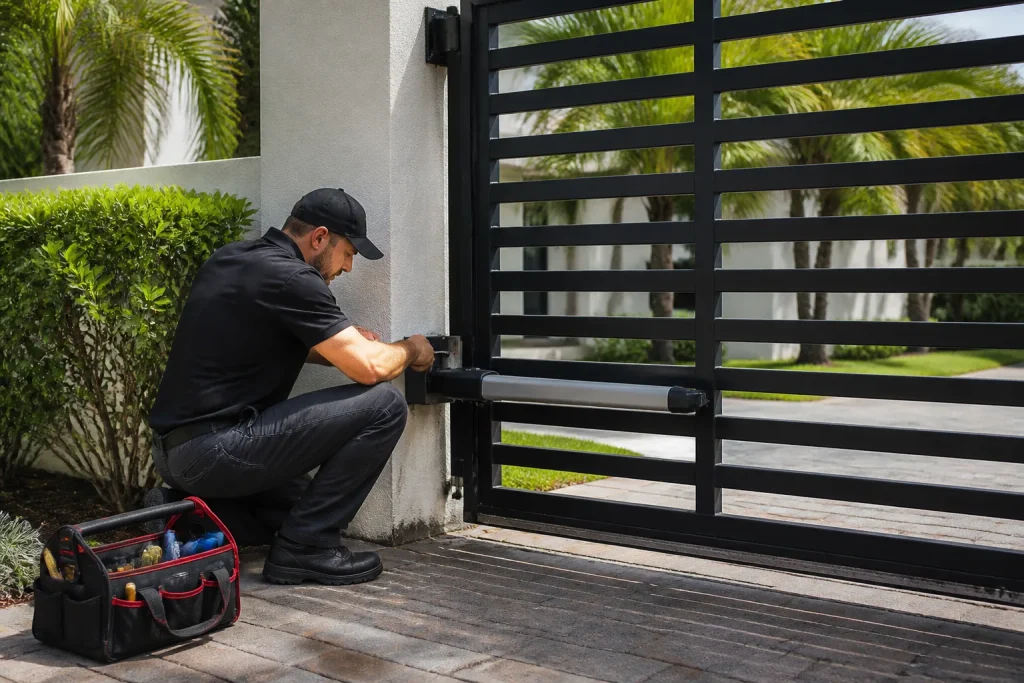
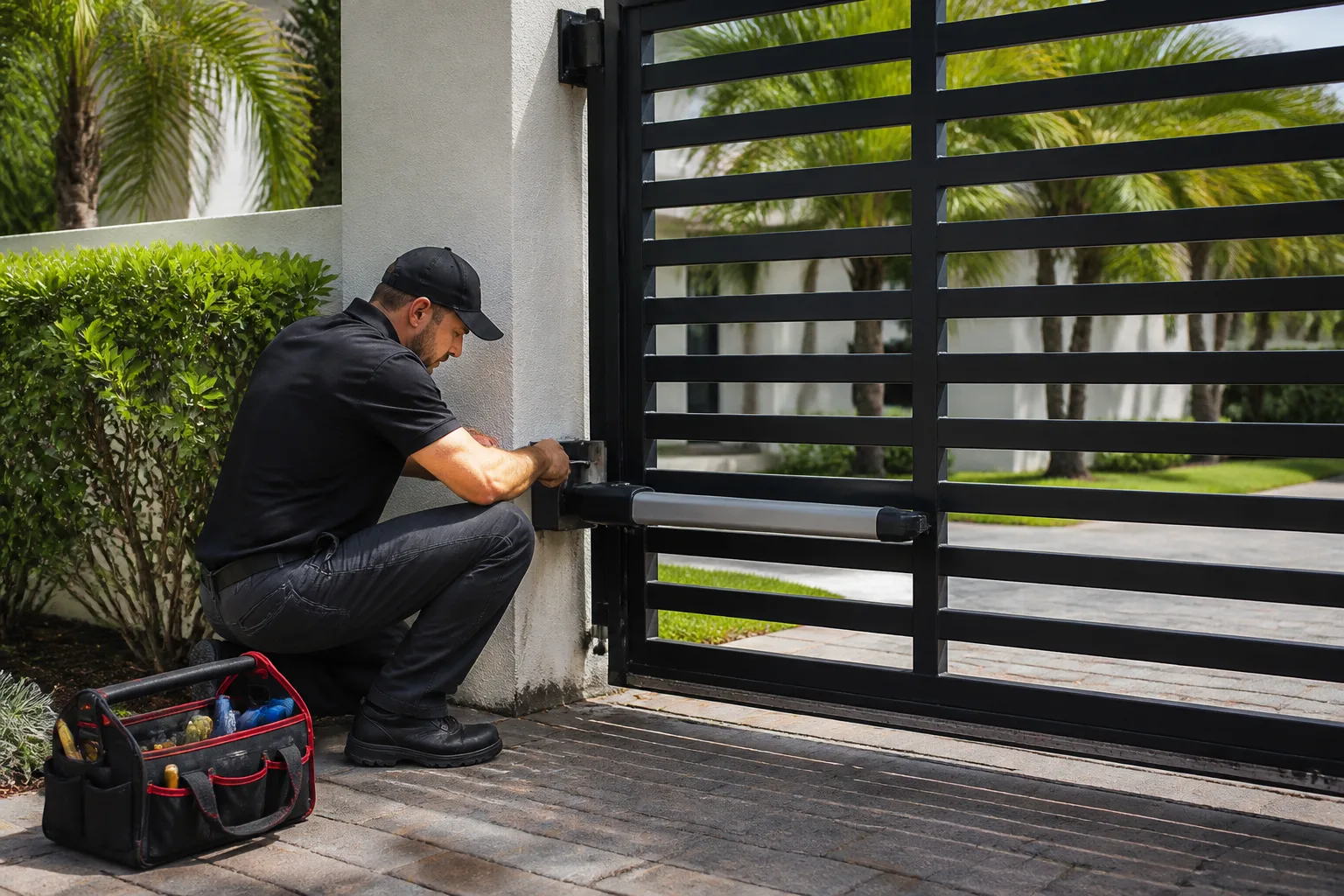
Gate Repair What It Really Costs: What Tampa Homeowners Pay in 2026
Gate repair in Tampa typically costs between $95 and $2,800 depending on what actually failed. The honest answer is that “gate repair” covers everything from a fifteen-minute sensor alignment to a full operator and post replacement that takes two technicians most of a day. If you’d rather not DIY the diagnosis, call Kingston Gate Repair in Tampa at (877) 752-3303 and we’ll tell you exactly what’s wrong and what it costs before any work starts.
Here’s the thing most cost articles get wrong: they give you one tidy number and call it a day. That’s not how gates work. We’ve pulled operator covers off in Carrollwood and found a fried control board. We’ve driven down to South Tampa for a “gate won’t open” call and found the remote battery was dead. Same symptom, wildly different invoices. Three quotes for the same call can all be legitimate if the technicians found different things. That’s what this piece is about: the real cost structure, the line items, and what’s padding versus what’s necessary.
What Gate Repair Actually Costs in Tampa: A Tiered Breakdown
Here are the price ranges we’re seeing across Tampa in 2026, broken down by repair category. These reflect actual market rates, not national averages that ignore Tampa’s labor market and supplier network.
- Remote, sensor, and minor electrical fixes: $95 to $250. This covers remote reprogramming, photo-eye or safety-loop alignment, battery replacement, and limit-switch adjustments on most residential operators. Quick in-and-out work. The parts are cheap. You’re paying for the diagnostic know-how and the truck roll.
- Mechanical hardware repair: $180 to $620. Hinge replacement on a swing gate, wheel or track work on a slide gate, chain tensioning, bracket reinforcement, and gate sag correction. Labor-heavy work, especially when the gate has to come off its hinges and be re-set. On a slide gate in Brandon with a bent track, the track itself might be $90 but the labor to get it straight and rolling smooth is where the real cost sits.
- Operator motor replacement: $450 to $1,100. This assumes a residential-grade operator. Viking, Linear, Ghost Controls, and Mighty Mule all have replacement motors that fit this range for most single-family setups. You’re paying for the motor, the mounting hardware, and a couple hours of wiring and testing.
- Control board repair or replacement: $300 to $850. Control boards are the brain of the system. DoorKing and FAAC boards run higher because they’re built for higher duty cycles. Labor is typically one to two hours, but the board itself is often $250 to $600 depending on the brand. This is also the repair where we see the most misdiagnosis from generalists, because a bad board can mimic a bad motor, a bad sensor, or a bad remote receiver.
- Full operator replacement (motor and control unit): $1,200 to $2,800. This is the big one. When a twenty-year-old operator finally dies and repairing the existing unit doesn’t make sense, you’re paying for the new unit, the removal of the old one, wiring, programming, and safety-system verification. Commercial operators push this higher. A high-cycle DoorKing or FAAC swing operator for a small HOA entrance in Tampa can run $3,500 or more installed.
- Post and structural repair: $400 to $2,000+. This is the least-discussed category. Concrete post bases in Tampa sit in sandy, shifting soil. A swinging gate that pulls a post out of plumb doesn’t just need the gate fixed, it needs the post re-set in new concrete, which means digging, bracing, pouring, and waiting. In neighborhoods like Seminole Heights where lots are older and post footings were poured shallow forty years ago, we see this constantly.
Note that none of these numbers include Tampa permit costs where they apply, which we’ll get to below. And none are set in stone. Aluminum gates repair cheaper than steel. Walk-gates cost less than a 16-foot driveway swing. But this is the real structure of gate repair pricing, and it’s the structure you should use when budgeting.
The Upsells Tampa Homeowners Actually See: Which Are Legitimate and Which Are Padding
Every invoice has line items. Some are necessary. Some are not. Here’s what we see on real repair invoices across Tampa, from Temple Terrace to Westchase, and how to tell the difference.
Legitimate add-ons you’ll see and should expect:
- Safety-loop or photo-eye replacement: $150 to $400. If a technician re-sets a safety loop but the wire in the ground is broken, swapping the loop is necessary for the gate to function safely. This is not an upsell. It’s the reason your gate doesn’t close on your car or your kid.
- Backup battery replacement: $80 to $200. Most operators have a DC backup battery for power outages. After three to four years, they degrade. A technician should test and quote replacement when it’s at end of life, not wait for it to fail during a summer storm.
- Track cleaning and lubrication: $35 to $100. Slide gates in Tampa collect sand and salt air. Regular cleaning extends the motor’s life. This is maintenance, not padding, but it should be a small line item.
Padding you should question:
- “Full system tune-up” bundled at $300 to $500 when you called about a beeping keypad: A tune-up is a real thing. Bundling it onto a simple repair because the tech is already out is a sales tactic. It may be worth doing, but it should be quoted as optional, not tacked on.
- There’s no emergency work until after 10 PM, and the after-hours fee is 50%. Standard after-hours premiums in Tampa run $75 to $150 over the normal service call, with some companies adding a separate trip fee on holidays. If the fee is described vaguely, ask for the exact number before they roll.
- Replacing the whole board when one relay is burned: Some boards have replaceable relays or fuses. A technician who works on Linear, Viking, and DoorKing boards regularly knows which ones can be component-repaired and which can’t. If you hear “whole board replacement” within five minutes of diagnosis and the repair is north of $600, get a second opinion.
We’re a Kingston Gate Repair home specialist, so we see invoices from all over the city and can tell when a tech is padding a bill versus pricing a genuine repair. The single best protection you have is asking for the diagnosis in plain English before authorizing work. If the explanation sounds like a fog machine, ask again or call someone else.
What Tampa Permits and Code Requirements Do to Your Gate Repair Bill
Most national cost articles completely ignore permits. That’s a problem for Tampa homeowners because Hillsborough County and the City of Tampa have specific rules about automatic gate operators, and those rules affect both cost and timeline.
In unincorporated Hillsborough County and within Tampa city limits, adding a new automatic gate operator or significantly modifying an existing one can require an electrical permit. The gate operator is treated like electrical work: it needs to be wired to code, which means a licensed electrical contractor may need to be involved if the power run from the house to the gate post doesn’t meet current standards. A permit for gate operator work typically adds $50 to $150 to the job, but that’s the cheap part. What it really adds is time. Depending on the municipality and inspection backlog, you might wait a few days to two weeks for an inspection, which matters if your gate is the only thing securing your property.
Here’s where it gets specific to Tampa: many older homes in areas like Palma Ceia or Riverside Heights have gate posts that were never wired for modern operator requirements. If a homeowner replaces a dead Viking operator with a new one and the old power line is undersized or not properly grounded, the repair becomes a two-visit job with a contractor in the middle. That’s a legitimate cost that has nothing to do with the operator itself.
We mention this because national cost sites that tell you “gate motor replacement: $650” are quoting a number with no awareness of Hillsborough County’s electrical code. If your existing operator is a like-for-like swap, no permit is usually needed. If you’re upgrading from a manual gate to an automatic one, or changing the operator type, budget for the permit and a possible electrician’s hour.
Related services in Tampa: if you’re replacing the whole gate rather than repairing it, see gate installation in Tampa. If the problem is electrical beyond just the operator, our electric gate repair in Tampa service may be relevant.
Why Emergency and After-Hours Gate Repair Commands a Premium
Emergency gate repair in Tampa costs more, and there’s a reason that isn’t just price gouging. When your gate won’t close at 11 PM in New Tampa and your car is stuck inside or outside, the technician who shows up is doing something operationally different from a scheduled visit.
The premium, typically $75 to $150 above the standard rate, buys you three things. First, parts availability. A technician running emergency calls keeps common parts on the van: control boards for the most common operators, capacitors, limit switches, remote receivers, and emergency release hardware. Stocking that van is expensive. Second, dispatch priority. Emergency calls pull a technician off their evening or weekend, which means scheduling elasticity for everyone else gets re-worked. Companies absorb that cost or pass it along. Third, certification level. A tech who can safely diagnose a high-voltage capacitor or a gate that’s failed in the open position at night has more training than someone who only does routine replacements. That training costs the company money, and it shows up in emergency rates.
We had a call in Citrus Park last spring: a slide gate on an HOA entrance failed in the closed position at 9:30 PM. The board was fried. We had the replacement in the truck and the gate running again by midnight. The homeowner paid an after-hours premium, but the alternative was leaving the whole community entrance dead until morning with cars backing up on the main road. That’s not a premium for speed; it’s paying for the parts van to have the board on board.
When to call a pro: if the gate is failing in a way that leaves your property unsecured, or you hear grinding, or the operator is making a humming sound but not moving, stop running the motor. You can make the problem worse. Kill power to the operator via the breaker and call a specialist. If it’s a high-tension spring on a manual gate, don’t touch it. Those springs can release with enough force to cause serious injury. That’s a repair for a trained technician, no exceptions.
Repair vs. Replace: The Real Cost Math Tampa Homeowners Should Do
There’s a point at which repeated repairs stop being frugal and start being expensive. The threshold isn’t a single number; it’s a ratio. Here’s the calculation that actually matters.
Take the cost of the repairs you’ve made in the last 24 months and add the next repair you’re considering. If that total is 50% or more of the cost of a full operator and hardware replacement, replace. If not, repair. That’s the rule of thumb we use, and it holds up because gate failures tend to cluster. A dead control board at month three is often followed by a worn motor at month ten followed by a failed capacitor at month fourteen. Each bill looks manageable. The pattern is the signal.
Why 24 months? Because that’s the lifespan of most wear components on a residential operator when it’s past its prime. A gate that’s been in service for fifteen years in Tampa’s salt air and humidity is going to keep failing in new ways. At some point, you’re not repairing a gate; you’re financing its retirement in installments.
One more hidden cost: downtime. If your gate is shared with tenants or affects daily business access, even a one-day outage costs more than the repair invoice. Property managers in Tampa we work with often already know this math. They replace at a lower threshold because a down gate is a legal liability, not just an annoyance.
The Bottom Line
Gate repair in Tampa costs anywhere from $95 for a sensor alignment to $2,800 for a full operator replacement, with most common repairs falling between $200 and $800. The number depends on what actually failed, and the only way to know is a proper diagnosis. Watch for padding in the form of vague tune-up bundles and unnecessary board replacements, but expect legitimate costs for safety loops, permits, and after-hours dispatch. If the math says replace, replace. If you’re in Tampa and need a specialist to look at your gate, Kingston Gate Repair offers free estimates on repair and installation. Call (877) 752-3303.
Frequently Asked Questions
Gate repair in Tampa costs $95 to $2,800 depending on the failure. Sensor and remote fixes run $95 to $250, mechanical hardware repair $180 to $620, operator motor replacement $450 to $1,100, control board work $300 to $850, and full operator replacement $1,200 to $2,800. Call (877) 752-3303 for an exact quote on your specific gate.
An electric gate that hums but doesn’t move usually points to a failed capacitor, a worn motor, or a mechanical binding issue like a stuck wheel or bent track. In Tampa, operators deal with salt air and humidity that degrades these components over time. The fix ranges from $150 for a capacitor to $1,100 for a motor replacement. A specialist can diagnose it in about thirty minutes.
You typically don’t need a permit for a like-for-like operator swap in Tampa. You may need an electrical permit if you’re upgrading from manual to automatic operation or changing the operator type in a way that requires new wiring. Permit costs run $50 to $150, and inspection wait times can add days to your repair timeline.
Use the 50% rule: if your repairs over the last 24 months plus the next estimated repair total half or more of a full replacement, replace the gate. Repeated small failures on gates older than fifteen years in Tampa’s climate usually mean the system is wearing out in clusters. A replacement operator with new hardware often costs less than two years of patchwork.
Written by the team at Kingston Gate Repair, serving Tampa since 2013.
Need Gate Repair Help?
Call Kingston Gate Repair — licensed & insured, here with fast after-hours help in Tampa.
(877) 752-3303